
Engineering software
Building product configurators for complex engineered products
How to structure requirements, governed product data, compatibility rules and quotation workflow when configuring complex engineered products.
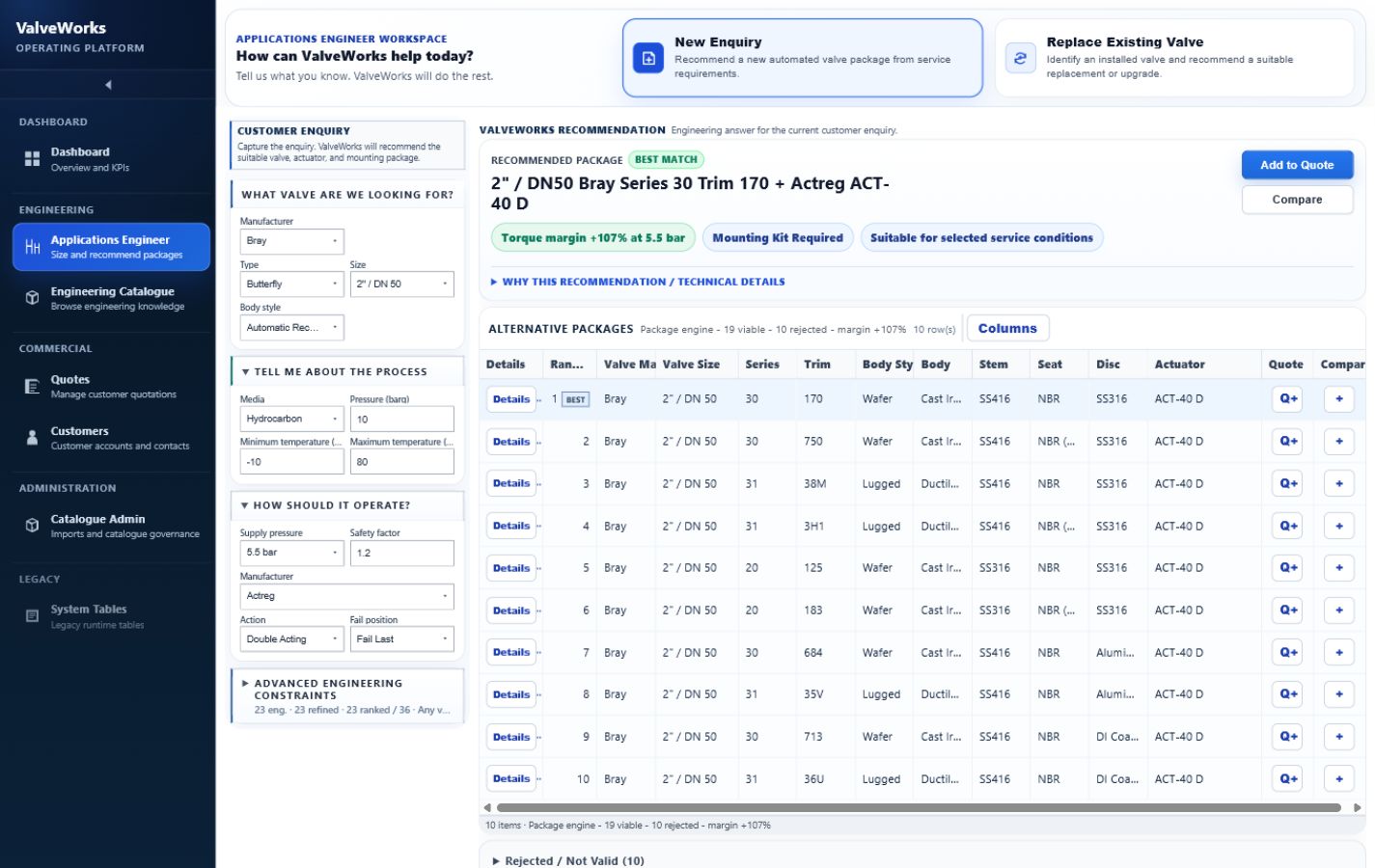
A configurator for engineered products is not simply a catalogue with more filters. The system must interpret an application requirement, identify technically valid options, assemble compatible components and carry the result into a commercial process without losing the engineering reasoning.
That makes product configurator development a data and rules problem before it is an interface problem. A clear experience depends on the structure underneath it.
Start with the engineering decision
A useful configurator begins with the decision the user is trying to make. That may involve sizing a product, selecting a family, building a package or checking whether a proposed combination is suitable for a particular duty. The input form should express that task in the language of the user, not mirror the columns of a database.
The underlying model can then translate those requirements into constraints and comparable values. Keeping that translation explicit makes it possible to improve the user experience without changing the engineering meaning of the request.
Separate four kinds of information
Many configurators become difficult to maintain because unlike information is stored and processed as though it were the same thing. A more dependable structure separates the application requirement, authored product facts, derived results and the commercial package.
- Requirements describe the duty, environment, preferences and constraints supplied for the application.
- Product facts are approved manufacturer data such as ratings, dimensions, materials and available options.
- Derived results come from calculations, unit conversion, compatibility checks and ranking logic.
- Commercial records capture selected items, quantities, pricing, readiness and quotation output.
Make the rules inspectable
Compatibility matrices and calculation rules often begin in spreadsheets, technical manuals or the experience of senior engineers. Before they become software, each rule needs a clear input, outcome and reason. This allows the same logic to be tested directly and explained in the interface.
A candidate should not simply disappear when it fails. Where useful, the system should record that a rating was insufficient, an option was unavailable or a required combination was invalid. Rejected-candidate reasoning helps engineers validate the model and gives commercial users a more credible explanation of the result.
Ranking is different from validity
Several products may be technically valid. Choosing the preferred result may then involve size, availability, margin, standardisation or another business preference. Those ranking factors should not be mixed invisibly into the pass/fail rules.
A clear design first establishes eligibility, then applies an explicit ranking policy. This makes it possible to change a commercial preference without altering the engineering boundary, and it allows a user to understand why the preferred candidate was presented first.
Connect configuration to quotation carefully
For engineered products, configuration and CPQ overlap but are not identical. A configured package may still need review, customer-specific pricing, documentation or approval before it is ready to quote. The software should expose that readiness rather than treating a technical recommendation as an issued commercial commitment.
A useful hand-off carries the selected product revisions, required accessories, assumptions, exceptions and calculation trace into the quotation record. Re-entering only the final part number discards much of the value created by the configurator.
Build the first vertical slice
The first release should cover one meaningful product family or application path end to end: requirements, governed facts, deterministic checks, a recommendation, visible reasoning and a reviewable package. That slice provides stronger evidence than a broad catalogue with shallow logic.
From there, new families and rules can be added through the same governed model. The aim is a product selection system that becomes easier to extend as knowledge is added—not a larger collection of special cases hidden behind a polished screen.